How PrecisionCOW collars, powered by Nedap, help farmers monitor thermal conditions, protect fertility and support herd welfare to meet processor requirements.
Thermal stress management is now a mainstream part of dairy welfare discussions, with growing emphasis on proactive monitoring and early intervention during warmer conditions.
While heat stress is often associated with extreme summer temperatures, many UK dairy farms experience periods of elevated thermal stress risk far earlier and more frequently than farmers might expect. Humidity, housed conditions and collecting-yard environments can all contribute to increased thermal load, even during relatively moderate weather.
In fact, with typical spring-to-summer humidity levels of 60% in the UK, cows can begin to experience thermal stress at temperatures of just 21-22oC. Also, within sheds, temperatures can run around 7oC higher than outside air, and it becomes clear that heat stress risk can build on days that feel comfortable to people.
As dairy welfare expectations evolve, processors are updating requirements to include thermal stress monitoring. So, farmers will need to find practical ways to continuously monitor thermal conditions across the herd and respond quickly when cows are under pressure in order to remain compliant with new regulations.
PrecisionCOW collars are eligible for the Farming Equipment and Technology Fund. View more here.
Why thermal stress matters and may be more urgent than UK farmers realise
The impact of thermal stress extends far beyond cow comfort alone. Research and on-farm experience continue to show significant effects on fertility, feed intake, rumination, milk production and overall herd performance.
Heat-stressed cows often show:
- Reduced feed intake
Lower rumination
Increased standing and restlessness
Reduced milk production
Poorer fertility performance
Increased health challenges
While heat stress is frequently assumed to be a problem reserved for extreme summer heatwaves, the data tells a different story: risk can build at relatively moderate temperatures, and fertility and performance can be affected well before cows show obvious outward signs.
The relationship between thermal stress and fertility is particularly important. Research from Dutch dairy herds shows that once the Temperature Humidity Index (THI) rises above 60, conception rates fall by around 10% and calving interval lengthens by up to five days. Calving interval begins to worsen at THI 50 - a level routinely reached on UK dairy farms in spring and summer. Research from a commercial dairy unit in southern England found that the milking parlour exceeded the critical THI threshold of 68 for 86% of milking time during warm periods, frequently reaching severe stress levels.
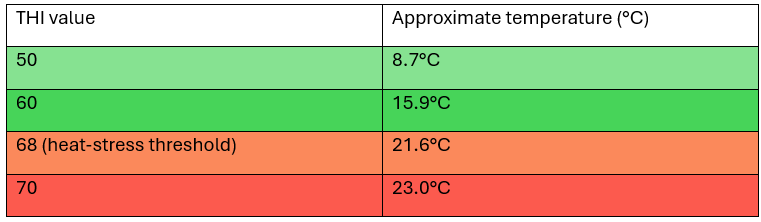
Heat stress is not an occasional summer nuisance. For many UK herds, it is a recurring risk from April through to September, making routine monitoring and timely intervention essential to protect welfare and performance.
From reactive to proactive: what continuous monitoring changes
Traditionally, heat stress management has relied on visual observation: farmers responding when cows are visibly panting, standing excessively or showing obvious signs of discomfort. By that point, the welfare impact and reproductive and production costs have already begun to accumulate.
Continuous THI monitoring changes decision making, shifting management from reactive to proactive. Rather than responding to symptoms, farmers can act on conditions – identifying periods of elevated stress risk and making timely management interventions before the herd is materially affected.
Such interventions include:
- Adjusting ventilation
Activating fans and sprinklers
Altering grazing schedules
Changing milking times
Adapting feed delivery routines
Prioritising higher-risk groups within the herd.
Continuous monitoring adds the confidence to deploy the right interventions at the right time and provides the data to know whether they are working.
How PrecisionCOW supports thermal stress monitoring
PrecisionCOW collars, powered by Nedap, monitor the ongoing thermal stress risk across the herd through regular THI calculation. The system combines environmental temperature data measured at cow level via the collars with humidity data sourced from local public weather stations to calculate THI.
THI does not diagnose heat stress, but provides a scientifically grounded indicator of when cows are likely to be under thermal pressure. Heat stress levels are calculated every 15 minutes when cows are in range of the readers, providing farmers with timely visibility of changing thermal conditions during key periods such as housing and milking.
Four levels of heat stress severity are identified – none, mild, severe and very severe – and farmers can see at a glance which sheds or areas are under pressure and for how long. The system logs duration at each level, supports area-level notes, and integrates thermal condition data alongside fertility, health, and production information in a single platform.
Validation data from test farms demonstrates that timely interventions can reduce heat stress by at least one severity level. Moving a herd from severe to mild stress, for instance, may be sufficient to restore normal heat expression and protect conception rates.

Protecting fertility during warmer conditions
For many herds, fertility performance remains one of the biggest concerns during periods of elevated heat stress. One of the most commercially significant benefits of continuous thermal monitoring is its impact on reproductive management.
As THI rises and cows become heat-stressed, they express oestrus for shorter periods with less intensity, making visual detection unreliable at precisely the time when accuracy matters most and increasing the likelihood of missed heats. Even relatively small declines in submission or conception rates can have significant financial implications, particularly in block-calving systems or high-performing herds.
For block-calving herds, a missed heat means a cow risks slipping outside the calving block, with financial consequences that can take multiple seasons to fully unwind. For year-round calving herds, every undetected heat delays a breeding cycle by three weeks and compounds the impact of calving interval.
PrecisionCOW’s collar-based monitoring detects subtle behavioural shifts – changes in activity, rumination and feeding patterns – that precede and accompany heats, flagging animals for attention before the oestrus window closes, along with THI monitoring that identifies when thermal conditions are suppressing oestrus expression.
Combined with strong reproductive management, high-quality genetics and effective cooling strategies, proactive thermal monitoring can play an increasingly important role in maintaining herd performance through warmer conditions.
Supporting evolving welfare expectations
As dairy welfare standards continue to evolve and place greater emphasis on proactive thermal stress management, continuous monitoring technologies that measure temperature and humidity, alert when thresholds are exceeded, and monitor the areas where thermal stress risk is highest, are becoming an increasingly valuable part of modern herd management. Rather than relying on periodic checks or visible signs of heat stress, farmers gain access to continuous environmental and behavioural data that supports faster, more informed decisions.
PrecisionCOW collars, powered by Nedap, are designed to meet these requirements. By combining real-time THI monitoring with wider fertility, health and production insights, farmers can take a more proactive and informed approach to herd management that goes well beyond welfare compliance.
To find out more about PrecisionCOW, talk to your local Cogent Genetics Consultant or call us free on 0800 783 7258.